

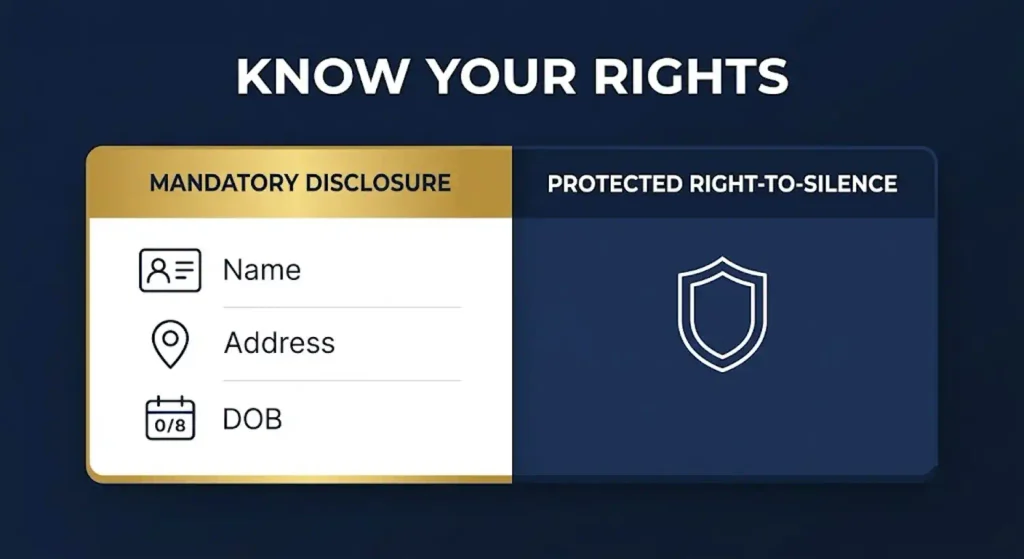
If an Ohio police officer stops you or starts asking questions, give your name, address, date of birth, and license, registration, and insurance when asked. That part is required. Beyond that, you do not have to answer questions about where you were going, what you were doing, or whether you have anything illegal in your car, and if an officer pushes toward a question that could amount to admitting a crime, politely ask to speak to an attorney before answering. Comply with the basics, hold the line on anything incriminating.
Most people never study criminal procedure and have no training in this area. Police officers, on the other hand, are trained to gather evidence, including anything you say out loud. Miranda warnings, the familiar “you have the right to remain silent,” only apply once you are under arrest. Before that point, anything you say to an officer can be used against you, even if you are never formally arrested.
Mizak & Pacetti, a Parma law firm, handles criminal defense and traffic cases throughout Cuyahoga County, including OVI stops, drug charges, and traffic violations that start with an officer asking questions on the side of the road. Attorney Vincent Pacetti, a former Cuyahoga County prosecutor who has handled more than 100 trials in Northeast Ohio courts, wrote this guide based on what he has seen work, and not work, in real cases.
You Have to Follow the Officer’s Instructions
Everyone has a legal duty to follow the lawful orders of a police officer, even if you believe the stop or the investigation is a mistake. If an officer activates lights or a siren behind you, pull over as soon as it is safe to do so.
If pulling over immediately would be unsafe, such as in a construction zone with no shoulder, continue at a reduced speed with your hazards on until you reach the next safe location, then stop. Arguing about the stop or refusing to comply will not help your case. It usually makes things worse.
What You Must Say During a Stop
Under Ohio Revised Code 2921.29, you must give your name, address, and date of birth if an officer has reasonable suspicion that you committed, are committing, or are about to commit a crime. Beyond that, the statute itself says you do not have to answer any other questions.
For a routine traffic stop, this also means providing your driver’s license, vehicle registration, and proof of insurance when asked, and stepping out of the car if the officer instructs you to. These are basic compliance items, not admissions of guilt.
Refusing to give your name, address, or date of birth when an officer has reasonable suspicion is a fourth-degree misdemeanor in Ohio, punishable by up to 30 days in jail and a $250 fine. A separate charge, obstructing official business under Ohio Revised Code 2921.31, applies to acts that intentionally delay or hamper an officer, such as giving a false name, and carries a heavier penalty of up to 90 days in jail and a $750 fine. Providing accurate identifying information avoids both charges entirely.
Stay Calm and Polite, But Stop There
When the officer approaches, remain calm and polite. Acting hostile or difficult increases the chance of being charged or getting a worse outcome, and it will show up on the officer’s body camera or dash camera footage.
Answer basic questions: your name, date of birth, and where your registration and insurance are located. Comply with instructions, like stepping out of the vehicle if asked.
The line to hold is anything beyond that. Never admit to committing a crime, and never say anything that could give the officer probable cause to search further or investigate a new angle. If an officer asks a question that goes beyond basic identification, politely say you would like to speak to an attorney before answering.
Common questions that fall into this category include:
- “Do you know why I pulled you over?”
- “Do you mind if I take a look in your trunk?”
- “Have you had anything to drink tonight?”
- “Do you realize you were swerving back there?”
For each of these, the same response works: “I’d rather speak with an attorney before I answer that.” The officer may get frustrated, and in rare cases may even arrest you, but you put yourself in a far better position to fight the case afterward. Ohio’s own consumer guidance on this point is direct. The Ohio State Bar Association tells residents that you have no legal duty to answer questions beyond identifying yourself, and you may refuse to answer, though you should never lie to an officer, since that can lead to an obstruction charge on its own.
Vehicle Searches: You Can Say No
An officer needs your consent, a warrant, or a specific legal exception (like visible contraband) to search your vehicle without one. If an officer asks to search your car, you are allowed to say no. A simple, polite response is enough: “I don’t consent to a search.”
The officer may search anyway if they believe they have another legal basis. If that happens, do not physically resist or argue on the roadside. State clearly that you do not consent, then let the issue go to court, where your attorney can challenge the search if it was not legally justified.
DUI and OVI Stops in Ohio
If an officer suspects impaired driving, the questions get more pointed, and the stakes get higher. Ohio’s implied consent law means that by driving on Ohio roads, you have already agreed to chemical testing if you are lawfully arrested for OVI. Refusing that test carries its own license suspension, separate from any OVI charge itself.
OVI stops are common in Cuyahoga County and across the state. Ohio State Highway Patrol troopers alone made more than 90,000 OVI arrests over a recent five-year period statewide, with about 30 percent involving repeat offenders. During an OVI stop, questions like “how much have you had to drink” and “where are you coming from” are designed to build the officer’s case before you are ever arrested. You are not required to answer them. The same rule applies: identify yourself, comply with lawful instructions, and decline to answer investigative questions until you have spoken with a lawyer.
The Speeding Ticket Exception
There is one situation where a different approach sometimes makes sense: a minor traffic stop, like speeding, where nothing else is going on. No alcohol, no drugs, no weapons, nothing that could turn a traffic stop into a criminal case.
In that narrow situation, a calm, honest admission can sometimes result in a warning instead of a ticket, especially if your driving record is clean. If you choose to take this approach, a sincere apology, a brief explanation (running late, misjudged the speed limit), and a polite thank-you tends to work better than a flat admission.
This is a judgment call, and it depends on the officer, the situation, and your own driving history. It is never the right approach if there is any other reason you could get into legal trouble during the stop.
Talk to a Lawyer After Any Police Encounter
Regardless of how the stop ends, whether you get a warning, a ticket, or something more serious, talk to a lawyer as soon as possible afterward. In many cases, an attorney can take action that prevents or reduces charges before they are ever formally filed.
If you were pulled over, questioned, or arrested anywhere in Parma, Parma Heights, Seven Hills, Brooklyn, Brooklyn Heights, Independence, Broadview Heights, North Royalton, Brecksville, or Cleveland, the attorneys at Mizak & Pacetti handle criminal defense and traffic cases at Parma Municipal Court, which covers traffic and misdemeanor cases for all of these communities, as well as felony arraignments before cases move to the Cuyahoga County Court of Common Pleas.
Common Misconceptions About Talking to Police in Ohio
Misconception: You have to answer any question a police officer asks.
Fact: Under Ohio Revised Code 2921.29, you are only required to give your name, address, and date of birth when an officer has reasonable suspicion of a crime. You are not required to answer any other questions.
Misconception: Refusing to answer questions makes you look guilty.
Fact: Declining to answer investigative questions is a legal right, not an admission of guilt. Courts do not treat a polite request for an attorney as evidence of wrongdoing.
Misconception: If you didn’t do anything wrong, you should just explain your side to the officer.
Fact: Officers are trained to gather evidence, and any explanation you give before an arrest can be used against you later, even if you believe it is harmless. Saving your explanation for your attorney and the court usually works out better.
Misconception: You can be arrested just for staying silent.
Fact: Ohio Revised Code 2921.29 specifically states that failing to answer questions beyond your name, address, and date of birth is not grounds for arrest, as long as you provide that basic identifying information when it is required.
Frequently Asked Questions
Do I have to answer police questions during a traffic stop in Parma, Ohio?
No, beyond providing your name, address, date of birth, and your license, registration, and insurance. Ohio Revised Code 2921.29 only requires identifying information when an officer has reasonable suspicion of a crime. You can politely decline to answer further questions and ask to speak with an attorney.
What happens if I refuse to show ID during a stop in Ohio?
If an officer has reasonable suspicion that you committed, are committing, or are about to commit a crime, refusing to give your name, address, and date of birth is a fourth-degree misdemeanor under Ohio Revised Code 2921.29, punishable by up to 30 days in jail and a $250 fine. Giving false information instead of refusing can lead to a more serious obstructing official business charge.
Can police search my car without my permission in Cuyahoga County?
Not without a warrant, your consent, or a specific legal exception, such as visible contraband in plain view. You can say “I don’t consent to a search” if an officer asks. If they search anyway, do not resist. Your attorney can challenge an improper search afterward in Parma Municipal Court or Cuyahoga County Common Pleas Court, depending on the charge.
Should I admit to speeding if a Parma police officer pulls me over?
Only if speeding is the sole issue, with nothing else in play (no alcohol, drugs, or other violations), and your driving record is clean. In that specific situation, a calm and sincere admission sometimes results in a warning. This approach is risky and depends on the officer, so it is never appropriate if anything else about the stop could lead to criminal charges.
What court handles traffic and OVI cases from Parma and the surrounding suburbs?
Parma Municipal Court, located at 5555 Powers Blvd in Parma, handles traffic violations, OVI cases, and misdemeanors for Parma, Parma Heights, Seven Hills, Brooklyn, Brooklyn Heights, North Royalton, and Broadview Heights. Felony cases start there for arraignment before moving to the Cuyahoga County Court of Common Pleas.
Does refusing a breathalyzer test in Ohio get me out of a DUI charge?
No. Ohio’s implied consent law means refusing a chemical test after a lawful OVI arrest triggers an automatic license suspension separate from the OVI charge itself. Refusing does not prevent the officer from pursuing an OVI charge based on other evidence from the stop.
Is it ever a good idea to explain my side of the story to a police officer?
Generally no, especially before an arrest. Officers are trained investigators, and Miranda warnings only apply after an arrest, meaning anything you say beforehand can be used as evidence. It is usually better to save your explanation for your attorney, who can present it strategically in court.

Talk to Mizak & Pacetti About Your Case
If you have been pulled over, questioned, or arrested anywhere in Parma or the surrounding Cuyahoga County communities, the attorneys at Mizak & Pacetti are available to talk through what happened and what comes next. Attorney Vincent Pacetti, a former Cuyahoga County prosecutor, focuses on criminal defense, DUI and OVI defense, and traffic violations throughout Northeast Ohio. Get a free consultation today!

Jason, a partner at Mizak & Pacetti, LLC, brings 18 years of experience in estate planning, estate administration, business law, and civil litigation. He specializes in preserving family legacies, managing estates, and resolving disputes. Jason also handles real estate issues, asset management, and business disputes within estates, providing strategic, empathetic legal solutions.