
No. Not every estate in Ohio has to go through probate. Whether probate is required depends on how the deceased owned their assets, whether beneficiaries were named, and the total value of the estate. Assets held in joint tenancy, named in a payable-on-death account, placed in a living trust, or titled with a transfer-on-death designation pass directly to heirs without any court involvement. Only assets owned in the deceased’s name alone, with no designated beneficiary and no automatic transfer mechanism, are subject to probate.

Ohio also offers two simplified procedures for smaller estates. Under Ohio Revised Code Section 2113.03, estates worth $35,000 or less, or up to $100,000 if everything passes to a surviving spouse, may qualify for a Release from Administration. Under Section 2113.031, estates worth less than $5,000 may qualify for a Summary Release, which involves no formal probate proceeding at all.
Families in Parma, Seven Hills, Parma Heights, and surrounding Cuyahoga County communities frequently contact Mizak & Pacetti after a parent or spouse passes away, unsure whether they need to open a probate estate or whether assets can transfer without court involvement. The answer depends entirely on what the deceased owned and how it was titled. This post covers the rules, the thresholds, and the most common situations Ohio families face when dealing with probate and estate administration.
What Is Probate in Ohio?
Probate in Ohio is a court-supervised legal process for settling a deceased person’s estate. According to the Cuyahoga County Probate Court, a probate estate is a legal proceeding that determines the assets of a deceased Ohio resident, assigns their value, and distributes them to the people entitled to receive them under a will or under Ohio law.
Probate accomplishes three things: it validates a will if one exists, ensures outstanding debts and taxes are paid, and transfers the remaining assets to heirs. If no will exists, the Ohio intestacy statutes in the Ohio Revised Code determine who inherits.
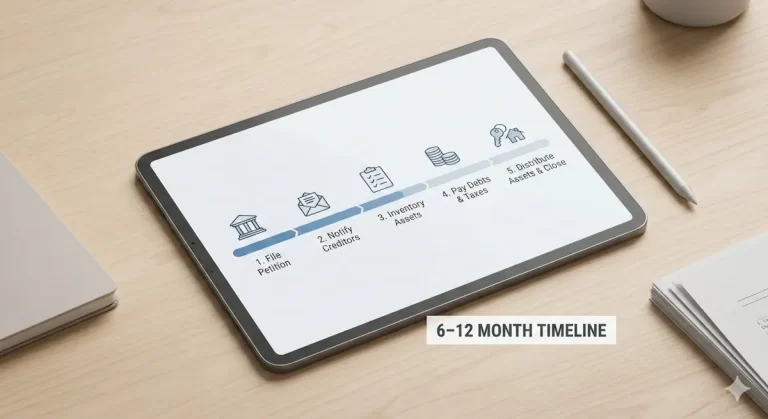
The court appoints a personal representative, called an executor if named in a will or an administrator if the court selects one, to manage the process. That person inventories assets, notifies creditors, pays debts, and distributes what remains. Most straightforward probate cases in Ohio close within nine months, because creditors have six months under Ohio Revised Code Section 2117.06 to file claims.
Which Assets Require Probate in Ohio?
An asset requires probate in Ohio when the deceased owned it solely, in their name alone, with no joint owner, no named beneficiary, and no transfer-on-death designation. The type of asset is less important than how it was titled.
Assets that typically require probate:
● Real estate titled only in the deceased’s name, with no survivorship deed or TOD designation
● Bank accounts without a payable-on-death (POD) beneficiary
● Investment accounts without a transfer-on-death (TOD) registration
● Vehicles titled solely to the deceased with no TOD designation
● Personal property above small estate thresholds
One fact that surprises many Parma families: having a valid will does not avoid probate. A will must be filed and validated by the Cuyahoga County Probate Court before it directs anything. The will controls how assets are distributed through probate, it does not bypass it.
What Passes Outside of Probate in Ohio?
Several categories of assets transfer at death without probate court involvement. Ohio law provides multiple mechanisms for this, and each one works independently of whether a will exists.
Joint Ownership with Survivorship Rights
Property owned jointly with rights of survivorship passes automatically to the surviving owner when one owner dies. No probate is needed. This applies to real estate held under a survivorship deed, joint bank accounts, and vehicles with joint titling. The surviving owner typically needs to file paperwork showing the other owner died, but no court proceeding is required.
Payable-on-Death and Transfer-on-Death Designations
Under Ohio Revised Code Section 2131.10, bank accounts with a payable-on-death designation transfer directly to the named beneficiary at death without probate. Similarly, investment accounts registered in TOD form and real estate with a transfer-on-death designation affidavit recorded under Ohio Revised Code Section 5302.22 pass outside the probate process. The property owner retains full control during their lifetime and can revoke or change the designation at any time.
Revocable Living Trusts
Assets held inside a properly funded revocable living trust bypass probate entirely. The trust owns the assets during the creator’s lifetime. At death, the successor trustee distributes them according to the trust’s instructions without court oversight. This is particularly useful for Parma and Cuyahoga County families who own real estate, have assets in multiple states, or want to keep estate matters out of the public record.
Life Insurance and Retirement Accounts
Life insurance proceeds and retirement accounts, including IRAs and 401(k)s, pass directly to named beneficiaries at death. These accounts do not go through probate regardless of what a will says. Keeping these beneficiary designations current is important because they override any contrary instruction in a will.
Ohio’s Small Estate Shortcuts: When Probate Is Simplified or Skipped
Even when some assets are technically subject to probate, Ohio law offers simplified procedures that can resolve smaller estates in weeks rather than months.
Release from Administration (Ohio Revised Code Section 2113.03)
Under Ohio Revised Code Section 2113.03, an estate may be released from full administration when the total probate assets are worth $35,000 or less, or when all assets pass to a surviving spouse and the estate does not exceed $100,000. This simplified process typically takes two to four months and involves significantly less court involvement than standard probate.
Summary Release from Administration (Ohio Revised Code Section 2113.031)
When the total estate is worth less than $5,000, or when the assets are just enough to cover funeral expenses, families may apply for a Summary Release under Ohio Revised Code Section 2113.031. This option involves no formal probate proceeding at all. A surviving spouse may also qualify for Summary Release when assets are worth less than $45,000, all assets pass to the spouse, and funeral costs have been paid.
These thresholds apply only to probate assets. Assets passing by beneficiary designation, joint ownership, or TOD deed do not count toward the limits.
What Does Probate Cost in Cuyahoga County?
According to research by Solomon, Steiner & Peck, Ohio probate typically costs between 3 and 7 percent of the total estate value when all fees are combined. Cuyahoga County Probate Court requires a $250 court cost deposit to open a standard estate, which in most cases covers all court filing fees. Additional costs include executor or administrator fees, attorney fees, and, in some cases, appraisal fees.
Attorney fees for probate in Cuyahoga County are governed by Local Rule 71.1 of the Cuyahoga County Probate Court, which sets a fee schedule based on a percentage of the estate’s value. Executor and administrator fees follow a similar statutory structure under Ohio law. Family members who serve as executor often waive this fee, particularly when they are also beneficiaries.
Ohio has not had a state estate tax since it was repealed effective January 1, 2013. Federal estate tax may still apply to larger estates, but the current federal exemption is above $13 million per individual, meaning most Ohio families are not affected.
Probate and Estate Administration in Parma, Parma Heights, and Seven Hills
Families in Parma, Parma Heights, Seven Hills, Brooklyn, Independence, and surrounding communities who need to open a probate estate file with the Cuyahoga County Probate Court, located at 1 West Lakeside Avenue in downtown Cleveland. The court handles will validation, executor appointments, creditor notifications, asset inventories, and final distributions for all Cuyahoga County residents.
Mizak & Pacetti is a Parma-based family-owned law firm that handles probate and estate administration cases regularly in Cuyahoga County Probate Court. The attorneys at Mizak & Pacetti live in the Parma community, and clients work directly with attorneys, not with staff or intake teams, from the first conversation through the closing of the estate.
Common Misconceptions About Ohio Probate
Misconception: Having a will means your estate avoids probate.
Fact: A will does not avoid probate. According to the Ohio State Bar Association, a will must be presented to the probate court and validated before it has any legal effect. The will directs how assets move through probate; it does not remove the requirement.
Misconception: If you die without a will, the state takes everything.
Fact: Ohio’s intestacy statutes, found in Ohio Revised Code Chapter 2105, distribute assets to surviving spouses, children, parents, and siblings in a specific order. The state only takes property in extremely rare cases where no living relatives exist and no other heirs can be located.
Misconception: Power of attorney gives someone authority to manage the estate after death.
Fact: A power of attorney expires at death. It has no effect on probate. The authority to manage a deceased person’s estate comes from the probate court through letters of authority issued to the executor or administrator.
Misconception: Probate always takes years and costs a fortune.
Fact: Most straightforward probate cases in Ohio close within nine months. The process costs between 3 and 7 percent of the estate value according to Ohio estate planning sources, and small estates under $35,000 may qualify for a simplified process that typically resolves in two to four months.
Frequently Asked Questions
Does every Ohio estate have to go through probate?
No. Many Ohio estates avoid probate entirely or at least avoid it for most of their assets. Assets with named beneficiaries, payable-on-death designations, transfer-on-death registrations, or joint ownership with survivorship rights pass outside of probate automatically. Only assets titled solely in the deceased’s name, with no transfer mechanism in place, are subject to Ohio probate court oversight.
How long does probate take in Cuyahoga County?
Most standard probate cases filed with the Cuyahoga County Probate Court take around nine months from start to finish. Ohio law requires the process to remain open for at least six months to give creditors time to file claims under Ohio Revised Code Section 2117.06. Estates with disputes, tax issues, or complex assets can take twelve months or longer. The simplified Release from Administration process typically resolves in two to four months.
My dad died without a will. What happens to his house in Parma?
If the home was titled solely in your father’s name with no survivorship deed and no transfer-on-death designation, it will go through probate at the Cuyahoga County Probate Court. The court will distribute it according to Ohio’s intestacy statutes, which in most cases means it passes to the surviving spouse first, then to children. An administrator will be appointed by the court to handle the estate, and that person must file a land inventory and ultimately deed the property to the heirs through the probate process.
What does it cost to open a probate estate in Cuyahoga County?
The Cuyahoga County Probate Court requires a $250 deposit to open an estate, which typically covers all court filing fees for straightforward cases. Total probate costs, including attorney fees, executor fees, and appraisal costs, generally run between 3 and 7 percent of the estate’s value. Attorney fees in Cuyahoga County probate are set by Local Rule 71.1 of the Cuyahoga County Probate Court. Family members who serve as executor sometimes waive the executor fee, particularly when they are also receiving an inheritance.
Can we skip probate if my mom’s estate is small?
Possibly. Ohio offers two shortcuts for smaller estates. If the total probate assets are $35,000 or less, or up to $100,000 if everything passes to a surviving spouse, the estate may qualify for a Release from Administration under Ohio Revised Code Section 2113.03. If the estate is worth less than $5,000, a Summary Release under Section 2113.031 may be available with no formal probate at all. These thresholds apply only to assets that would otherwise require probate, so assets with named beneficiaries or joint ownership do not count toward the limit.
Does a living trust avoid probate in Ohio?
Yes, if it was properly funded before death. A revocable living trust avoids probate for any assets that were transferred into the trust during the creator’s lifetime. The successor trustee distributes those assets privately according to the trust’s terms without court involvement. Assets left out of the trust, or acquired after the trust was created but not added to it, may still require probate. Mizak & Pacetti helps Parma-area families set up and fund living trusts as part of estate planning.
My parents live in Seven Hills. Do they need to go to downtown Cleveland for probate?
Yes. All Cuyahoga County probate matters, including estates for residents of Seven Hills, Parma, Parma Heights, Brooklyn, and Independence, are handled by the Cuyahoga County Probate Court at 1 West Lakeside Avenue in Cleveland. In practice, most families work through an attorney who handles the court filings on their behalf, so the family rarely needs to appear in person for most of the process.
What is a transfer-on-death designation affidavit and can it really avoid probate for a house?
Yes. Under Ohio Revised Code Section 5302.22, Ohio property owners can record a transfer-on-death designation affidavit with the county recorder’s office that names a beneficiary to inherit the real estate at death without probate. The owner keeps full control of the property during their lifetime and can sell, refinance, or change the beneficiary at any time. When the owner dies, the beneficiary records a simple affidavit with the Cuyahoga County Fiscal Officer to transfer the title. No court involvement is required.

Talk to a Probate Attorney in Parma, Ohio
Mizak & Pacetti handles probate and estate administration, wills and trusts, and estate planning for families throughout Cuyahoga County, including Parma, Parma Heights, Seven Hills, Brooklyn, Independence, and surrounding communities. Attorney Jason B. Mizak has practiced estate and probate law in Ohio since being admitted to the bar in 2006.
Call (216) 398-9870 to speak directly with an attorney, or contact us online to schedule your consultation. No intake staff, no call centers. Mizak & Pacetti offers free consultations for probate and estate matters.

Jason, a partner at Mizak & Pacetti, LLC, brings 18 years of experience in estate planning, estate administration, business law, and civil litigation. He specializes in preserving family legacies, managing estates, and resolving disputes. Jason also handles real estate issues, asset management, and business disputes within estates, providing strategic, empathetic legal solutions.