
When someone passes away without a will in Ohio, they are considered to have died “intestate.” That means the State of Ohio decides how their assets are distributed under Ohio law, rather than the individual’s wishes.
For families in Parma, Ohio, and throughout Cuyahoga County, this can create confusion, delays, and sometimes serious conflict at an already difficult time. If you are dealing with this situation, working with a local probate and estate administration lawyer in Parma can help you avoid costly mistakes and move the process forward correctly.
At Mizak & Pacetti, this is one of the most common probate situations we help families navigate.
How Ohio Decides Who Gets What
Ohio follows a strict legal formula under Ohio Revised Code § 2105.06 to determine who inherits when there is no will.
The court does not consider verbal promises or personal intentions. It follows the statute.
Here is how it generally works:
Spouse and No Children
The surviving spouse typically inherits the entire estate.
Spouse and Children from That Marriage Only
The spouse usually inherits everything.
Spouse and Children from Another Relationship
This is where things become more complex. Ohio law applies a structured formula depending on the family situation:
- If there is one child who is not the child of the surviving spouse, the spouse receives the first $20,000 plus one-half of the remaining estate
- If there are multiple children, the spouse receives the first $60,000 plus one-third of the remaining estate
This applies whether:
- The spouse is the parent of some but not all children, or
- The spouse is not the parent of any of the children
This is one of the most commonly misunderstood parts of Ohio probate law, especially in blended family situations.
No Spouse
Children inherit everything equally.
No Spouse or Children
Assets pass to parents, then siblings, then extended family members.
These rules can lead to outcomes families did not expect, especially when relationships are complicated or informal agreements were never documented.
The Probate Process Without a Will
Dying without a will does not avoid probate. In many cases, it makes the process more complicated.
Here is what typically happens:
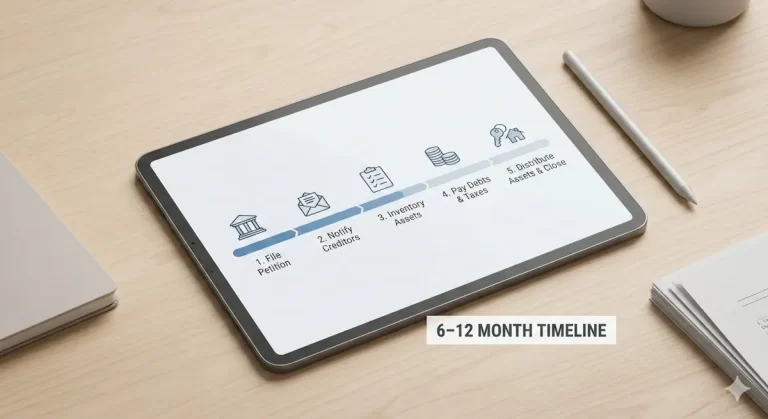
- A probate case is filed with the county probate court
- The court appoints an administrator instead of an executor
- Assets are identified, gathered, and valued
- Debts, taxes, and expenses are paid
- Remaining assets are distributed according to Ohio law
Because there is no will providing instructions, the court plays a larger role in decision-making, which can slow things down.
Who Becomes the Estate Administrator?
When there is no will, the court appoints someone to manage the estate. This role is called the administrator.
Priority is generally given to:
- Surviving spouse
- Adult children
- Other close relatives
If multiple people want the role, disputes can arise. The court will ultimately decide who is best suited.
Common Problems When There Is No Will
This is where we see the biggest issues.
Family Disputes
Without clear instructions, disagreements over money, property, or even personal items are common.
Delays
The probate process often takes longer because there is no roadmap.
Unintended Outcomes
Assets may go to relatives the deceased never intended to benefit.
No Guardian Designations
If minor children are involved, the court decides who becomes their guardian.
What Assets Go Through Probate?
Not everything is controlled by intestacy laws.
Some assets pass outside of probate, including:
- Life insurance policies with named beneficiaries
- Retirement accounts with designated beneficiaries
- Jointly owned property with survivorship rights
However, any assets owned solely by the deceased without a named beneficiary will go through probate and be distributed under Ohio law.
Why This Matters for Families in Parma
In communities like Parma, Parma Heights, Seven Hills, and nearby areas, we often see families assume things will “just work out.” Unfortunately, Ohio law is very structured. It does not account for personal relationships unless those wishes are clearly documented in a valid estate plan. Working with a local firm that understands how probate actually works in Cuyahoga County can make a significant difference in how smoothly the process goes. If someone passes away in Parma, the case is handled through the Cuyahoga County Probate Court in downtown Cleveland.
What Court Handles Probate for Parma Residents?
If someone passes away in Parma, the case is handled through the Cuyahoga County Probate Court in downtown Cleveland.
That means filings, hearings, and administrative steps are handled at the county level, not a local Parma courthouse.
FAQ
Q: My dad passed away in Parma without a will. Does his estate still have to go through probate court?
A: Yes, when someone dies without a will in Ohio, the estate almost always has to go through the Cuyahoga County Probate Court, which handles all probate matters for Parma and the surrounding suburbs. The court uses Ohio’s intestate succession laws to decide who inherits and will appoint an administrator to manage the estate since there is no will naming one. An experienced Parma probate attorney can handle most filings and court communication on your behalf so you can focus on your family.
Q: If there is no will, does everything automatically go to the surviving spouse?
A: It depends on whether the couple had children together and how assets were titled. If all children are also children of the surviving spouse, the entire estate generally passes to the surviving spouse under Ohio law. But in blended families, which are common throughout Parma and Parma Heights, the surviving spouse may only receive a portion, with the rest going to the children.
Q: Can my parent’s house in Parma be sold if they died without a will?
A: Not right away. If the home was titled solely in your parent’s name, it cannot be sold or transferred until the Cuyahoga County Probate Court approves it through the administration process. The sooner you connect with a Parma probate attorney, the sooner you can understand your options and avoid delays on the property.
Q: What if the estate is small? Does it still have to go through the whole probate process?
A: Not necessarily. Ohio has a simplified process for smaller estates, and if the total value is under $35,000, the family may qualify for a release from administration, which is much faster than full probate. The catch is that even a modest bank account or vehicle titled only in the deceased’s name can still trigger court involvement, so it is worth having an attorney take a quick look before assuming the process will be simple.
Q: Do I need a lawyer, or can I handle a no-will estate on my own in Ohio?
A: Ohio does not legally require an attorney for probate, but administrators are personally responsible for managing the estate correctly, and mistakes can cause delays or even personal liability. The Cuyahoga County Probate Court has specific local rules that trip up people unfamiliar with the process. Families in Parma often tell us they wished they had called sooner instead of trying to figure it out on their own first.

Talk to a Local Probate Lawyer in Parma
If a loved one has passed away without a will, getting guidance early can save time, money, and stress.
Mizak & Pacetti provides hands-on, local support for probate and estate administration matters. As a family-owned firm based in Parma, their attorneys understand the local courts, procedures, and challenges families face during probate.
They help with:
- Opening probate cases
- Handling estate administration
- Resolving disputes between heirs
- Ensuring assets are distributed correctly under Ohio law
If you are unsure what to do next, scheduling a free consultation can help you understand your options and move forward with confidence.

Jason, a partner at Mizak & Pacetti, LLC, brings 18 years of experience in estate planning, estate administration, business law, and civil litigation. He specializes in preserving family legacies, managing estates, and resolving disputes. Jason also handles real estate issues, asset management, and business disputes within estates, providing strategic, empathetic legal solutions.